

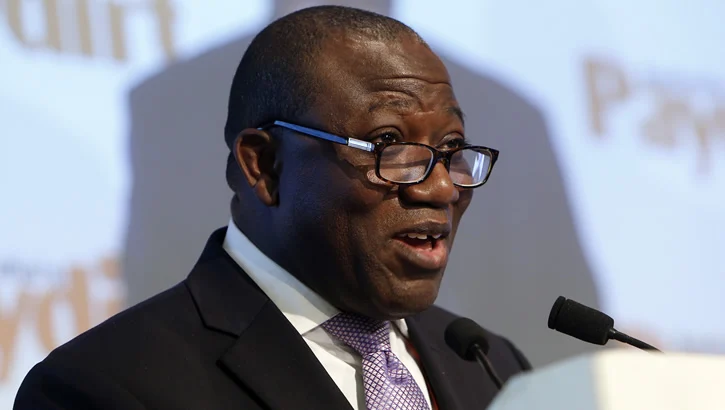
Former Ekiti State Governor, Kayode Fayemi, has described former Vice-President Atiku Abubakar’s proposal to rebuild petrol subsidy as a political strategy aimed at taking advantage of the hardship being experienced by Nigerians following the removal of the subsidy.
Fayemi, who spoke during an interview on Arise TV, likened Atiku’s proposal to the Muslim-Muslim presidential ticket adopted by the All Progressives Congress (APC) during the 2023 general election.
According to him, the proposal was more of a political calculation designed to appeal to Nigerians affected by the economic consequences of subsidy removal than an economic policy proposal.
“My take is that Atiku’s proposal on subsidy is the political equivalent of our own Muslim-Muslim ticket in 2023. It’s a political strategy. It’s not an economic construct,” Fayemi said.
Atiku, who has stated his intention to contest the 2027 presidential election, had said he would restore petrol subsidy if elected president.
The former vice-president also criticised the Federal Government over what he described as a lack of accountability concerning funds saved from the removal of the subsidy.
Atiku argued that the savings from subsidy removal should have been channelled into measures aimed at reducing poverty and financing development.
President Bola Tinubu, however, criticised the proposal, describing it as evidence of “serious ignorance” of governance and the economy.
Fayemi said he remained a supporter of the removal of petrol subsidy, noting that he had spent years advocating the policy.
He, however, faulted the manner in which the policy was implemented by the Tinubu administration, particularly the failure to put adequate measures in place to protect vulnerable Nigerians from its immediate economic consequences.
According to him, the groundwork for the removal of the subsidy had already been undertaken by the administration of former President Muhammadu Buhari before Tinubu assumed office.
“What President Tinubu inherited, in fairness to him, was the work that had already been completed by that [Buhari] administration. The only challenge it had was the way it was done,” Fayemi said
He explained that the Nigerian Governors’ Forum had previously worked with the Federal Government and the World Bank on a safety-net strategy designed to cushion the impact of subsidy removal on Nigerians who were expected to be worst affected by the policy.
Fayemi said the major weakness in the implementation was that sufficient measures were not put in place to protect poor and vulnerable Nigerians before the subsidy was removed.
He argued that many Nigerians who have borne the brunt of the policy were less interested in the technical arguments surrounding subsidy removal and more concerned about their ability to meet their basic needs.
According to the former governor, the continued hardship being experienced by vulnerable Nigerians has created an opportunity for opposition politicians to present policies that directly address their immediate economic concerns.
He therefore drew a parallel between the political considerations that informed the APC’s decision to field a Muslim-Muslim ticket in 2023 and what he described as Atiku’s strategy on petrol subsidy ahead of the 2027 election.
The decision generated significant political debate, with critics arguing that a Muslim-Muslim ticket did not adequately reflect Nigeria’s religious diversity